
Our last post ended with us getting ready to sail down the Yukon River for four days, from Dawson in Canada to Eagle in Alaska.
We were very excited. On what it would be like to sail with the bikes and all our gear. What we would think of it. And then the Yukon. A legendary big river with a lot of history, going all the way back to the heyday of the gold diggers.
The four days on the water went well, and we quickly decided that the boats should be used a bit more before they had to take them home to Denmark. After all, we are in Alaska, where the packraft, which is an inflatable rubber boat, was invented. In the beginning, the pioneers used different types of children's inflatable boats and a mat race under the raincoat as a life jacket, but all with the same purpose. Hike out into the wilderness where you can't bring your kayak or canoe and then sail back or to the next point on the journey. Or to cross rivers and streams that are too dangerous to cross without a boat. The boats have since been developed and fine-tuned, and today it is possible to buy boats for various purposes. Our packraft is an Alpacka Caribou, which has been developed to be able to have a heavy load mounted on the front of the boat, such as a bicycle or hunting booty.

We had read about a packrafting trip in Denali National Park, and since we wanted to visit the park anyway it was perfect to make our next boat trip there. You hike up along the Savage River, cross a low mountain pass and sail down the Sanctuary River. That was the information we had - it sounded simple. The trip is for those in a hurry one very long day, but we decided to spend two days as we wanted to enjoy the nature and have a night out in the wilderness.
We walked from the campsite where we left our bikes down to the Savage River. Here we spoke to a park ranger who confirmed that it was right next to the valley we could see in the distance. In the valley we could find an old wagon track, which is now a narrow single track, if we walked a little from side to side. It sounded fine. We were ready.

It looked easy from a bird's eye view, but it was somewhat more difficult to find the straight path than intended, and then the surface was difficult to pass. We walked on soft and bumpy tundra peppered with low bushes and thick scrub. Occasionally we found good animal tracks or perhaps the famous wagon track that took us a little faster, but it soon disappeared again. We stopped and looked at each other. The trail couldn't just stop, could it? Where had the animals run to? Or where did they think the best place would be to make a wagon track? We stood like this many times and had to guess what the new best route would be.


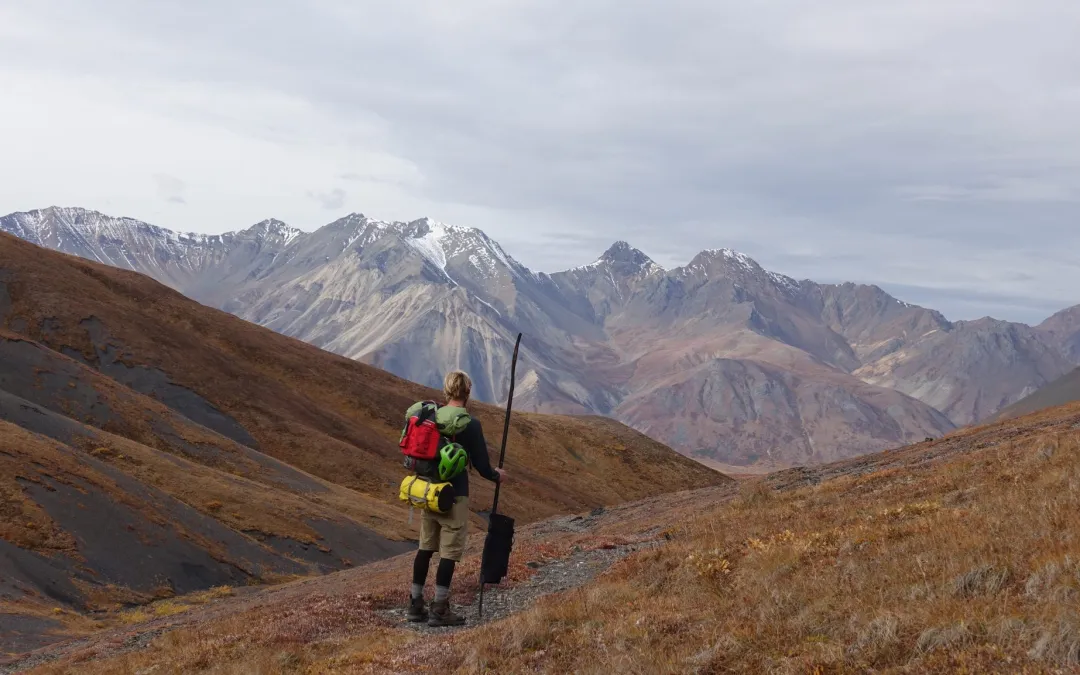
It was a beautiful day. A day in the wilderness. Even though it is a national park, it felt like being in un(s)polished nature, as there are no official hiking trails, but you can hike where you want if you have a backcountry permit. The mountains were dressed in autumn colors and bathed in sunlight most of the day. The air was fresh, but not cold. No noise, but only lovely sounds from the river gurgling down through the valley, from our shoes against the ground, from birds, hares and squirrels. We saw ptarmigans, Alaska's national bird, changing color from brown to white to better hide from enemies in the snow. So nice and funny as they first waddled, then flew away while scrambling. We also saw how the otters had been busy building dams. On the other side of the river, a large moose bull with huge antlers grazed. A moose bull weighs an average of 500 kg., can grow up to approx. 12 years and their antlers weigh up to approx. 30 kilos. Although they look cute, moose are more dangerous than bears when in heat, so we were perfectly fine admiring it from a distance. We also found quite a few antlers and we can confirm that they are really heavy. Even if you only hold one.


We had read that the hike would take approx. 6 hours, so we had left a little late when we thought we had plenty of time. The plan was to pitch the tent close to the Sanctuary river, so we were ready to sail the next morning. A few blisters and 10 hours later we still hadn't reached the pass we had to cross to get to the river.
That morning we continued walking in the tundra, but quickly decided to turn back down towards the Savage River. Jackpot. There was so little water in the river here that we could walk in dry shoes with a few jumps over small streams. We called it the highway because we could go fast compared to walking in the dense thickets.


We found a huge elk antler so we took pictures and admired it. When we were about to start again, Kenneth said - "there's a grizzly bear". It was not just a grizzly bear. It was a huge one, and we spotted one more. And they spotted us. We were way too close, maybe 20m. The recommended safety distance for bears is 100m! We said "hello bear" as we calmly retreated sideways back to the tundra. If we weren't wide awake before, at least we were now.

After a bit of looking at the map, we found the valley where we wanted to cross the pass. We went for the lowest pass and it worked. On the way up the mountain we met two large caribou bucks, which are part of the caribou family. They looked at us curiously. One in particular looked like it was thinking "I'm not afraid of you strange animals" as it elegantly almost danced across the mountainside. We sat down and looked at them. They are so beautiful with their large antlers, which in addition to the two antlers that stick out on either side, have an antler that sticks straight out. They use that to shovel away the snow so they can get down to the food in the winter. The entire antler is as high as the animal's body. The bucks continued to follow us for a while, then crossed the pass as easily as nothing and disappeared on the other side. A unique moment and another reason to get off the beaten track.


Another magical sight awaited us as we crossed the summit. An explosion of colors. It looked like a painting. Red plants. Yellow bushes. Berry. The river. And huge gray mountains with snow on top. Everything woven into each other like a blanket. It was so beautiful. We walked a little down the mountain to sit down and have lunch. Just to enjoy it a little longer. The surroundings, the grandeur and the silence.


We could see the river and it seemed to be close, but there was still quite a bit of demanding walking. And it's hard not to stop and eat blueberries when you're wading right through them.
The joy was great when we reached the river after a total of 16 hours of walking. We looked up at the high mountains where the river came from. This is what we dreamed of when we bought the boats. Wandering into nowhere and sailing back. We each took the packraft out of our backpacks and started inflating them with a pump bag. Kenneth said it took 10 times and a few breaths with his mouth to inflate the boat. We were still impressed that the pack power weighs only 2.25 kilos, how little it takes up when folded up, and how quickly it is ready to get on the water. The paddle also came up the bag and was assembled from its four pieces. The most awkward thing to wear is the life jacket, so a business idea must be to invent a life jacket that can also be taken apart. One packraft has a zip, so we can put luggage into the boat's air chamber itself, but since we didn't have very much with us, we fastened the bags with straps at the front and back of the packraft.


We put the boats in the water and solid ground under our feet was replaced by a current that carried us down the river. The water was so clear that we could see the bottom and we enjoyed the view with mountains in the background. In Whitehorse we had taken a packraft course, and that now came in handy as we had gained a better understanding of how to read the river. We had to constantly be on our toes to choose the right line, as otherwise we would be sailing in shallow water or into other obstacles such as trees that hung far beyond the river's edge and large rocks that you can either get stuck on or that can flip the boat. Conversely, with a positive sign, there is also the possibility of catching a 'wave train' and gaining extra speed. We also quickly learned that we couldn't celebrate for many seconds if we made, for example, a good turn, because inattention would mean we would end up in the wrong position and the boat would scrape against the bottom or we would get stuck on a sandbank.
The river twisted and when we came around a bend there were three large Caribou. They looked at us for a bit, then ran off. The water and speed picked up as we sailed down the river and it was really fun.


After three hours we arrived at the bridge and the road that goes through the national park, which was our final destination. We got the boats ashore, rolled them up and packed them into the rucksack. On with the rucksack and up the road, where we were lucky enough to get a lift 20 kilometers back to the campsite.
Happy, wet and tired, we looked at each other with a big smile. It had been fun and one of the best things we did on the trip. We are looking forward to using the pack power more - both with and without a bike. When you hike, you can get to places where you can't bring your bike. Like in the wilderness of Alaska, where you can be lucky to find an animal trail that you can follow for a while, only to end up again between dense bushes and tundra. And that's part of the charm. Finding your own way. That it is off the beaten track and that it requires effort. That the reward is great in the form of unique nature and wildlife.
We were lucky, the sun broke through the clouds the next morning so we could dry our wet clothes. Even though the waves hadn't been big on the river, it was still enough for us to get soaked. We packed up and were once again ready to continue on our familiar bikes further into Denali National Park. The park is 24,585 km2 of raw nature, of which only 147 km wind. gravel road through. The big star is the Denali mountain, also called McKinley, which is North America's highest mountain. We caught a glimpse of it the first day we drove into the park, but the rest of the time it was covered in clouds, as it usually is.


Cars are not allowed to drive in the park, so it is either by bus, by bike or on foot. Except for the last five days of the season, when people who have won a car lottery are allowed to drive their own car in the park. That was the time we were in the park. Our plan was to stay until the park was closed to all traffic and only open to cyclists or pedestrians, but the weather picked up and it was wet and grey. So after four days we got a lift out of the park. Perfect timing to have a shower and wash clothes on the last day before the campsite closed for the winter. It was high on the list after seven days without a bath. Especially since we didn't know when we would get the opportunity next.


