
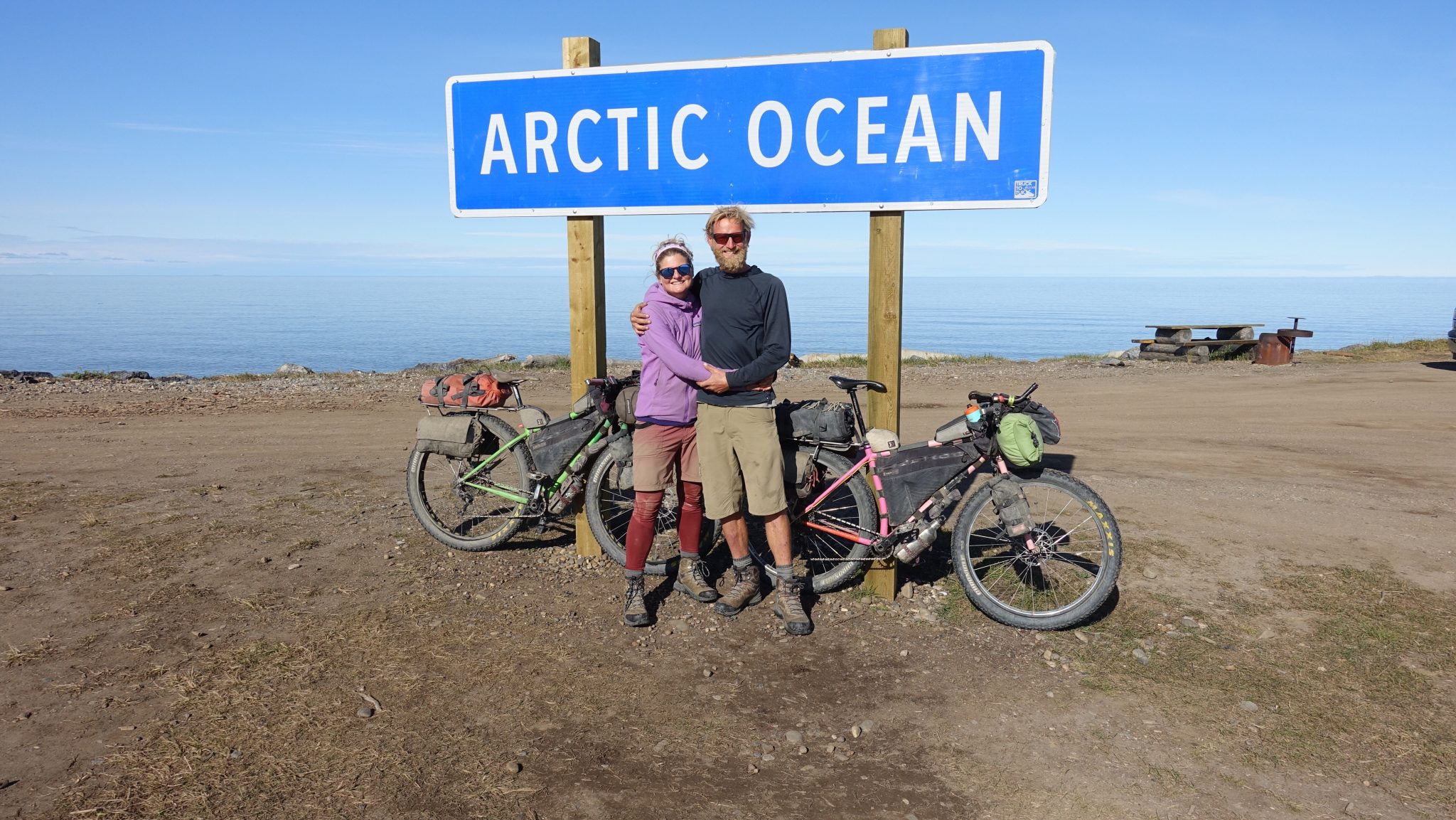

There are 930km from Dawson city to Tuktuyaktuk. There is only one road, the Dempster highway. Since last November, it has been extended all the way to the Arctic Ocean, rather than stopping in Inuvik. Before the new road, you could only get to the sea and the small Inuit community of Tuktuyaktuk, in winter, by the frozen McKenzie River. Also called 'The ice road'. Or by plane in the summer.
Dempster highway is famous and infamous for separating men from mice. It is notorious for destroying cars that try it. We heard many stories of cracked windshields, broken shock absorbers and gravel everywhere in the vehicle that was not even thought possible. Because the Dempster highway is a dirt road. All 886km of it. And it is not a nice and straight dirt road. It winds its way up over mountain passes, down through glacier-carved valleys, over the Arctic tundra and it already crosses the Arctic Circle well before its end. And then it's full of mud, ferry crossings that maybe, maybe don't work, and potholes. Lots of holes.


We thought that sounded absolutely perfect, and we had full confidence in our big wheels and our equipment to be able to handle the stretch. For once we even thought we had an advantage over the cars. Our bikes are built for that kind of terrain and it's the kind of terrain we love to ride. With the bags full of food for 4 days, we set off in the middle of August, out on the Dempster highway. The smile was big when we rounded the sign proclaiming 'Start of the Dempster highway'.
There is something hard alluring about this road. There is almost something mythical about it. And it's not just us who think so, because quite a few other tourists had packed their car/motorcycle/bike for the battle with the elements. We met some every day who were either on their way forward or back. A feeling of being in the same boat quickly arose. Everyone knew what the others were going through. Everyone tried to help each other as best they could. With good advice, with tools, spare parts, encouraging smiles, and sometimes some water and a snack.

We met a couple who wanted to give way to an oncoming truck. They just as quietly pulled out into the flowerbed with their four-wheel drive, and immediately the car began to slide down the muddy slope. When we passed by, they were waiting for a road-working machine, which was nearby, to take pity on them and come and pull them onto the road. But the road worker was obviously not super busy. The same thing had happened the day before.
Another motorist was returning after driving all the way to Tuktuyaktuk. When they drove into a campsite, still 600km from a normal country road, the front wheel fell off. It was the entire wheel suspension that had given up. They had to wait a few weeks for a friend from home to fly a spare part up to them. And then it was otherwise on with the work gloves and go-to fashion, to change the suspension myself.
We also met Thomas and Martina. A lovely German couple who live in Oregon. They drove along Dempster in their converted school bus. They were smarter than most and took it easy, so as not to destroy the car. At one point they turned around because the mud was getting in everywhere. But, in Inuvik we met them again. They had changed their minds and now went for the top anyway. The weather forecast was with them and they made it. However, we have not yet heard from them whether they have returned safely.


We didn't look too much at the weather forecast. We were just preparing for the weather to be anything imaginable. And it was. The first few days we cycled through Tombstone National Park, it rained in torrents. But we also had sun. So every time we got soaked, we could dry our clothes again. And that's how it changed all the time.
At the tourist office in Dawson city, they have a formidable service for cyclists. If you give them a cardboard box of food, they will make sure to bring it to the Eagle Plains hotel and gas station, which is halfway to Inuvik. And we did. When we entered the hotel, in our dung-stained raincoats, with empty food boxes, we asked for our food, which we had sent forward. Nobody knew anything about it. The box had not arrived. And the staff was far too busy to take care of it. It was a bit of a line in the bill. That meant 2-3 days to the next small town where we could buy food. The mood dropped quite drastically as we walked out the door again. But right there, in the entrance hall, was our cardboard box, haphazardly strewn on a bench in a corner. Cheers. We tore the cardboard apart, fished out a bag of nuts, and had a few big mouthfuls while sending a thought to the kind soul who had brought our food up here.


From Eagle plains the weather really started to show its teeth. We had to drive an average of a hundred kilometers a day, according to our own plan. On the sixth day we had driven 19km in the first 4 hours. The wind was relentless hurricane force. The bikes lay at a 45 degree angle to the wind. Hail lashed our faces. And the road just climbed and climbed and climbed towards the pass. We sat down behind a bush and found a peanut butter food. We checked ourselves and each other. Were we dry? Pretty much! Were we hot? Pretty much! Were we full? Yes - in a little while. We knew that if things went completely wrong, we could pitch the tent and crawl into the sleeping bag. So, everything was ok, no danger, just hard work. And a few hours later we stood at the top of the pass with big smiles on our faces. For some, this would be a really bad shit day. For us it was absolutely perfect.

As if by pure magic, it cleared up as we passed the Arctic Circle. A large sign marked that we were now moving up into the Arctic region. We ate lunch and drank coffee and enjoyed the view of a huge valley where around 150,000 reindeer hibernate every year. The vegetation became lower and lower and eventually the small spruce trees were completely gone and only the wide open tundra defined the hilly landscape. The tundra is like a marsh. It is tuberous and overgrown only with very low bushes and plants. The permafrost lies between 1/2 and 3m below the ground, which means that the roots cannot grow too far down. It is clear to feel that the ground is cold. In some places there are openings in the ground where you can see the ice from the permafrost exposed. And in other places there are large domed mounds called Pingos, also created by the frozen ground. It is quite a unique landscape, which we imagine you might also find in Greenland. And beautiful it is. We had timed our trip up the Dempster so that we could see, almost day by day, how the vegetation changed color to its autumnal robe. From green to yellow to red. Spectacular.


After a great effort the last two days, we reached Inuvik on the eighth day, as expected. We rolled down to the local campsite, and there met Simon and Simone, who we have previously spent some time with in the southern Yukon. They waited for the fourth week, for the right spare parts for their car, which had made a clonk sound. They were getting a little desperate, and eventually knew all of Inuvik's 3,000 inhabitants. As well as all the bars.
The mud and the hard road also took its toll on the bikes. The pulley wheels on both bikes were thoroughly chewed up. But they were perhaps also a little worn beforehand. And Kenneth broke a spoke. All in all, cheaply released on a road that is notorious for taking its toll.


But we were still missing the last bite for Tuktuyaktuk. The last 150 km dirt road, to the end of the road, to the arctic ocean. It was in high sunshine, high spirits and a tear of joy in the corner of our eye that we rolled down to the water's edge and dipped the front wheels of our beloved bikes in the icy water. The sea was completely calm and if we swam far enough, we would reach the North Pole.
We did it.


We cycled 29,000km from the southernmost tip of South America to the northernmost tip of North America (at least the northernmost you can get on a public road).
And maybe we are even the first in the world to cycle from Ushuaia to Tuktuyaktuk. We don't know for sure, but the road has only been open since November, so it hasn't been possible until this year. And we have not met, or heard of, anyone else who has done it.
Tuktuyaktuk is a fantastic small town with approximately 1,000 inhabitants. They are virtually all Inuit. The city has many brightly colored houses, smiling people and a warmth and joy that was incomparable. The perfect place to end 'From tip to tip'.
The past several days we have enjoyed being back in more challenging surroundings. Surrounded by different culture. It is our proper element. We have to admit that although North America has offered us many exciting experiences, in a way it has felt a bit more like a holiday than an adventure or an expedition. This is because everything is easy. It is our own well-developed culture. You have to create your own adventure to a greater degree by going out into the wilderness, compared to South America, where it was an adventure just to walk down the street in a foreign culture.


But Canada has been great. No doubt about it. The Yukon in particular has won our heart.
People in the Yukon are just cool. They live in a more simple way. More in touch with the great nature that surrounds them. More at one with the elements. There are some things that define the typical Yukon resident that we love. They love the outdoors. They do expeditions that are quite wild, without making a big deal out of it. They hunt and fish for their own consumption. And then they are warm and cordial.
No one in the Yukon represents that better than JM.
JM lives and works in Watson Lake. He has a wife and two children. And then he is a host through the network 'Warmshowers'. That's how we got in touch with him. On his profile he wrote 'guaranteed the friendliest host in the Yukon'. And we 100% agree. As we rolled into his driveway, he came out the front door, two cold beers in hand. Welcome. We were installed in his caravan and we could consider it our home for as long as we wanted. We only wanted to stay there for a single night, but ended up spending two days and three nights in the company of JM and his family. During that time we became good friends and JM alternately told us about cool ski touring routes he has done, fat bike tracks he builds on the frozen lakes in winter, winter races in the Yukon's -40 degree cold and his hunting trips to get the family a moose a year. All the stories were interspersed with hearty meals of pancakes for breakfast and elk meat for dinner. We are deeply grateful for his hospitality and willingness to share his life with us.


JM is not the only one who has taken us in, in Canada. But the stories would be too many if we were to mention them all.
In the Yukon, we saw how people hunt to a great extent to fill the freezer with their own meat. It is quite normal to shoot one moose and perhaps one more larger animal per year, in order to have meat for the whole year. It's the best way to get sustainable, local and organic meat in the freezer. As a hunter, you are not allowed to sell meat to others (that is the supermarket's right), so meat is generously given to friends and family, which provides a good connection in the small communities.
People also fish quite a bit, based on the same principles. Therefore, several times we met people who gave us fish in jam jars. They catch the fish and pressure cook them in the jars so they can last for 10 years or more. They are often used as gifts, to bond between people, and more than once we had a good meal on that account. The icing on the cake was when we hit the dried fish season in Nass Valley, where a family gave us a whole bag of delicious smoked salmon pieces.


Cycling through the Yukon has almost been a culinary experience. We got local honey from bees that live on fireweed flowers, and tea from mushrooms that grow on the birch trees.
For us, it's not just about being presented with local specialties and enjoying them. It points to a really beautiful and healthy way of living, which can be done in the great landscapes of the Yukon, namely that you live off what the earth offers you. This is how the Inuit and Native Americans lived for hundreds if not thousands of years here before the white man came. But unlike many other places, you still stick to that tradition as best you can.


Of course, it also has to do with size. Denmark is approximately 40,000 square kilometers, and we are close to 6 million people. Canada is almost 10 million square kilometers and there live under 40 million people. This means that the population density in Denmark is 133 people per square kilometer. In Canada there are 3. And most even live close to the US border. It means there is wilderness. Real wilderness. There are many places in northern Canada where there are hundreds of kilometers to the next sign of people. It gives a certain humility.


We could write much, much more about Canada. And we will definitely come back sometime. Or several times. We would have written more posts about our experiences and people we have met. But time has flown by. We've spent more time on the bike, we've tightened up the schedule and are trying to get as much done as possible before we fly home in about a month's time.


Tomorrow the bonus round, as we have dubbed it, starts. The last adventures before winter knocks and Denmark calls. We start by sailing our new packrafts down the Yukon River, with the bikes tied to the boat. It will be the way we arrive in Alaska again, for the last time. It will be a new type of adventure. And we are really looking forward to it.
