
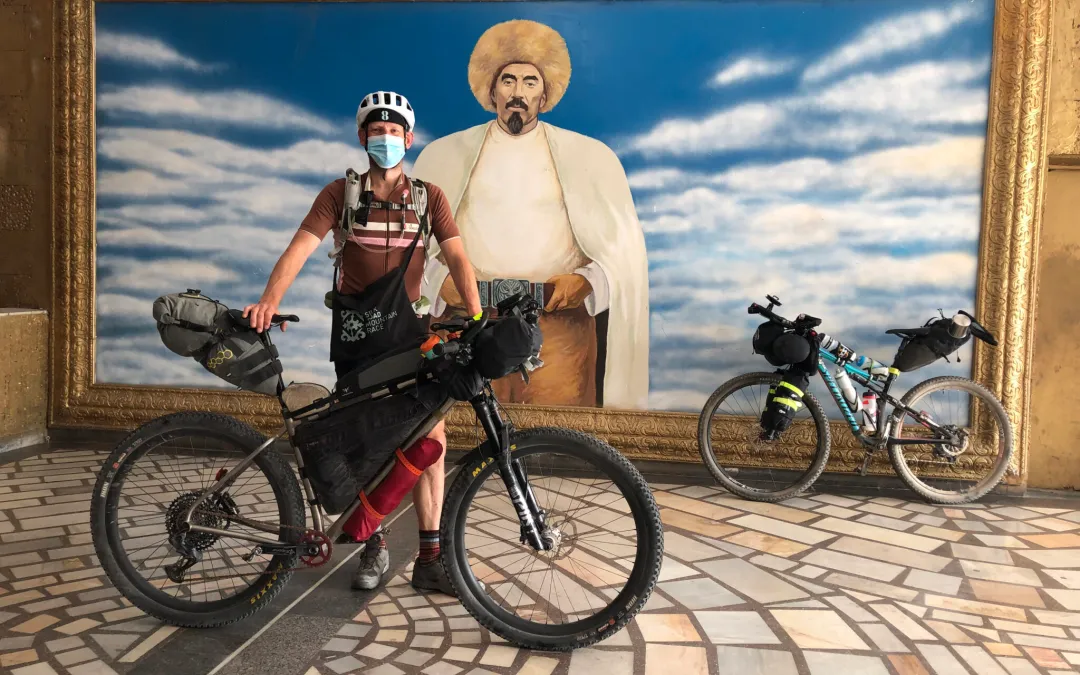
I have chosen to write my race report from the Silk Road Mountain Race 2021 quite extensively. My hope is that others who feel called to run the race can get as nuanced a picture as possible of what is required on as many different parameters as possible. I myself really enjoyed reading other people's accounts in my own research leading up to the race. And in the same way, I would like to share my experience for the benefit of others.
I divide the report into chapters so that it is easier to find selected points if you wish.
You are always welcome to contact me for good advice and to talk. Nothing too big and nothing too small. write on bikepackers.dk@gmail.com.
If you also want to listen to a podcast where Jakob Carlsen and I talk about our participation in the race, then have Balm for the soul had us in the studio for a good chat about the hardships.
Enjoy the reading.

Table of Contents
- What is the Silk Road Mountain Race - where does it take place?
- Background
- Preparation
- Departure and acclimatization
- Registration
- The race itself day by day
- Closing
- Reflection
- Silk Road Mountain Race Gear List
1. What is the Silk Road Mountain Race - where does it take place?
The Silk Road Mountain Race (SRMR) is an annual bikepacking race that some believe is the world's toughest bike race. I will leave that assessment to others.
The route changes from year to year. In 2021, when I ran the race, it was the third edition and the final official route looked like this:
1866 km. 30,090 meters of altitude. Lowest point 930 m. Highest point 3,950m above sea level. 16 mountain passes above 3,000m, of which 5 passes above 3,500m.
The race takes place in the Tian Shan mountains, in Kyrgyzstan. A poor country with approx. 6.5 million inhabitants. It is a former Soviet republic that seceded in 1991. The country is bordered by China to its east and south, Kazakhstan to the north, Uzbekistan and Tajikistan to the west and south. The country is very mountainous, in fact 90% of the country is above 1,500m above sea level. A large part of the population lives a traditional nomadic lifestyle in the mountains, where they drive horses and cows around. Wool and meat production are still a large part of the economy. Only Bishkek, which is the capital, sees a hint of modern lifestyle. Kyrgyzstan thus has a beautiful and exciting culture, spiced with a raw and enchanting mountain landscape, which together create a unique setting for a bikepacking race.
2. Background
Marie and I already started talking about bikepacking races during our Argentina-Alaska trip. We both love cycling and are always dreaming of new projects. We thought it might be fun to try a race, to add a stopwatch to our mountain biking experience. The choice immediately fell on SRMR because it looked beautiful and challenging.
In December 2019, while we were skiing in the Alps, we wrote our application to the race management. And in January 2020 we were told that we were approved to participate. But corona meant that the race in 2020 was cancelled. We transferred our tickets to 2021 and crossed our fingers. At the end of 2020 we felt that there was a good chance that the race would be completed and we intensified our training program with full focus on being able to run the race in August 2021.
3. Preparation
My preparation for the race spanned a long time. From the registration in December 2019 until the race took place in August 2021, the race was constantly on my mind. The training program itself started in earnest about half a year before departure.
My attitude to such a race is that it is not only about being able to ride fast on a bike. In fact, that's almost the least of it. Of course said with a twinkle in the eye, and with the underlying premise that you already have a pretty good basic form, if you even consider such a race. My philosophy was that I should identify my weaknesses across a broad spectrum and work on improving where I was worst. For the race itself, you often hit your own bottom level because you are under pressure, so in short it is about having a high bottom level.
To help that process, I categorized some areas that I needed to manage:
- Physical shape. Strength training. Cycling training. Training plan.
- Nutrition. General diet plan and nutrition during training, as well as nutrition during the race itself.
- Bike. Bags. Clothing. Equipment.
- Comfort and position on the bike. Bike fit.
- Vaccinations. Various medicines for the trip.
- Route understanding. Division of GPX file into desired segments.
- Strategies. Considerations about distances, speeds, overnight stays, etc., etc.
- Cultural understanding. Including understanding of customs, do's and don'ts and especially food cultures (nutrition).
As can be seen from the above, the physical training was only one part of a larger puzzle that must be completed in order to complete such a race.
I will in the following briefly touch on each point, not to exhaust the subject, but merely to give an indication of what my considerations were.
Physical shape
I put together a training program which involved 10-15 hours of cycling training, as well as 2-5 hours of running and strength training per week. In total, a total amount of training of 15-20 hours per week. I then put this into a larger schedule, where I intensified my training over three weeks and recovered every four weeks.
However, it is important to say that my life did not allow following the training program completely rigidly, so there were often changes and cancellations, which I think is good. It is important to keep your spirits up along the way and recognize that there is more to life than training. Just as it is extremely important to keep an eye out for symptoms of overtraining. In fact, I had the feeling that I peaked too early in the spring and that I did not show up for the race in my best cycling shape.
The training consisted of interval training and endurance training. That is short rides with maximum load and long rides, with many hours in the saddle, at a leisurely pace. I can only recommend that you read up on this before you throw yourself into a training course, or that you possibly contact a professional trainer who understands what an extreme bike race requires. It is very different from training for a road race. Strength training is an indispensable part of the training, in order to be able to sit for many hours in the saddle, in difficult terrain. It cannot be underestimated how damaged the body is during the race, and how much strength training can help prevent this.
When we left for Kyrgyzstan at the beginning of August, I had cycled approx. 8,500 training kilometers in the first 7 months of the year. An average of 1,200km per month.
Nutrition
With the amount of training I had planned, I also had to make a corresponding diet plan. I had previously had various experiences with missing various components in my diet. I consulted a dietician to put myself in the best possible shape. In addition to getting much better at putting together my diet optimally, the dietitian said that my biggest challenge as a vegetarian would be eating enough food in a day. I previously had a period before I started the intensive training plan where I tried to eat vegan but got sick from it. It is quite clear that if you train "normally", you must pay close attention to which supplements you need. When I got into the vegan diet, I didn't find any material about how much supplements were needed. I only found material praising the positive effects. It wasn't until I got sick and started telling people about it that I discovered that it often happens that people eat vegan for a period of time but get sick. I don't want to condemn either one or the other, but just emphasize how important it is, regardless of the type of diet you eat, that you familiarize yourself with what you need when you increase the amount of training as significantly as I did.
In addition to the daily diet plan, I also learned how important it is to eat and drink while on the bike. In my training sessions, I had been used to burning myself out completely, and then coming home to the couch very tired. But now I learned how great it is to eat and drink enough along the way and how much better I felt. Just as I discovered how much electrolytes did to bind the fluid in me, instead of just peeing it all back out. For some, this is common knowledge, but for me, who had never trained intensively before, it was a huge eye-opener. I've done a lot of mountain biking and bikepacking for fun in the past, so nutrition hadn't been on my radar. But it is an example of identifying weaknesses and then working on them.
Equipment
I am inserting an equipment list at the bottom. But in general, I can say that the choice of equipment was largely about minimizing weight and volume, while balancing economy and durability. I had a lot of equipment from previous trips, but I wanted to optimize weight as much as possible, so especially in terms of clothing, I optimized quite a bit. In short, I went from baggy shorts and merino clothes to tight and light lycra. I'm not sure there was a huge advantage in terms of wind resistance, but in terms of light materials, low pack volume and weather resistance, it was a good choice.
Through many weekend training trips with overnight stays, you become good at paring down to the most essential things you need.
My total dry weight for bike and equipment landed at approx. 23 kg. Which was more than hoped for. For another time, I will bet hard on hitting 20kg. But you must remember to never compromise with your own safety. Which means that you must be absolutely sure of being able to stay dry, warm and full in an unforeseen situation, in harsh weather in the mountains.
Bike fit
I geek out often and a lot with my bikes and the settings on them. Still, I chose to sacrifice a bike fit this time. My basic attitude is that you can always become smarter and more skilled. So for me, my bikefit was not only about setting a unique position on the bike, which I then had to maintain, but equally about understanding the effects on the body of the various setting options. Just as I discussed my various flaws with the bike fitter. That way, I can better remedy various problems myself. Especially during the race itself. I had to e.g. adjusting the position of the handlebars after riding a few days on a washboard because my wrists started to suffer. Because I knew exactly what to do, it only took me 30 seconds to adjust and the effect was immediate.
There are probably many good bike fitters in Denmark. I was looking for someone who had tried long races himself, with many hours in the saddle, and who had ridden a mountain bike himself. The choice fell on Thomas Bundgaard at Velofit in Århus. And no - I have no benefit from mentioning him. Besides those I experienced on the bike.
It is important that you focus on sitting comfortably on the bike, rather than sitting in a racing position. The race is long and the surface is hard, so it's more about sitting well, so you don't constantly want to get off and rest, rather than being able to drive fast in a sharp aero position.
Medicine
I have never taken medicine with me on my trips before. I think you can get everything you need at a local pharmacy, pretty much no matter where in the world you are. Often you still need local medicine, e.g. if you get parasites etc.
For a race, however, it's a completely different matter, because you don't have the time to drive to the nearest town and find a pharmacy. Just like you don't have time to be sick either. That's why I consulted the Travel Clinic, which are specialists in what you can encounter in the corners of the world. They helped me put together a medicine pack and vaccinations. I want to highlight a few things. Many in the race were affected by food poisoning. A large part of them had to drop out of the race. In addition to the obvious choice not to eat too much "exciting" local food, but to bring dry food myself, I got a Dukoral vaccine from home, which helps to avoid food poisoning. And I had no problems along the way. Another thing I want to highlight is antibiotics. I'm not a big fan of it, but again I was aware that it might be necessary. I got 2 different types. One for large open wounds to avoid nasty infections. And one for internal problems, i.e. primarily throat and pneumonia. I didn't imagine I would need it. But on the fourth day I got pneumonia and I was happy to be able to start a course of antibiotics right away.
Route understanding
I got a lot out of working with the final GPX file that we were given. I like to know the route, roughly, in my head. Knowing where I am and where I'm going, which area of the country I'm in, and what I can roughly expect gives me a sense of pride. So even though it is a foreign country to me, I still feel a bit at home, the more I have familiarized myself with the quirks of the route, curves, passes, cities, checkpoints, etc. Of course, this also has the advantage of avoiding frustrations and doubts , about which way I am going when I run the race. It may sound obvious, but I encountered several of the other riders along the way who cursed and sulked over curls on the route that they didn't understand. Or was driven incorrectly.
What I did concretely was that I took the total GPX file and divided it into 4 segments and thus 4 GPX files. These each represented the route between two checkpoints. For each of the 4 files, I then made a racesheet as a pdf document. I had this on my phone so I could find my way quickly. The pdf had height curves, maps, POIs and reminders for different situations. And last, but not least, were the cut-off times for the next checkpoint.
It was just as much the actual work of making these sheets that I understood the route better and better, which benefited me. Out on the route I might only look at it once a day to remind myself where I was.

Strategies
While working on the route, I thought a lot about strategies. Or rather, about possible strategies. Because I was always aware that things could change a lot. I considered provisioning places, stretches without water, where would be good to spend the night, where would it be bad to spend the night, where would the route be tough, where could I drive fast, etc., etc. All these considerations about strategies made me gain even more knowledge to the route and to what I could expect. Which in turn made the surprises less when I finally stood in the middle of the situation, out on the mountain. And I could make decisions more quickly about how to tackle the race because I already had an arsenal of possible solutions in the back of my mind.
I have only heard of a single rider who had meticulously planned all the day's stages and booked accommodation in advance. This is James Hayden, the top seeded rider. The fact that he never got to the start due to corona says a little about how much you can prepare, but still have to be prepared to tackle unforeseen events.
But the most important decision I made was that I didn't want to scratch. That is, I would not drop out of the race. I thought it would be okay if I didn't reach a cut-off in a checkpoint and thus was kicked out of the race. But under no circumstances would I choose to go out myself. Of course, unless I or the bike were so badly damaged that I couldn't continue.
Cultural understanding
In principle, it is not important where you are in the world when you sit on your bike and follow the red line on your GPS. It's about moving forward as quickly as possible, instead of stopping and talking to locals or enjoying the scenery. While I still think it is important to understand the country and the culture you are driving through, there are several layers to it. I think that out of pure respect for your surroundings, you should know the culture where you are. Especially when you're just racing across the country. If you know about customs and traditions, you can be a better guest in the country. And the short meetings you have with local people, usually at the grocery store, can still be rewarding for both parties. When you are on the bike, you can get a little more substance in your thinking if you know a little about the landscape, the people, the conditions and the culture. And it is also not unimportant to know a little about the food culture. It is good to know what to buy from the local grocery store that has the necessary nutrition. You often stand and look at food products that you have never seen before in your life. But when you know in advance what the locals live on, you make better and more nutritious choices.
4. Departure and acclimatization
Marie and I had signed up for the race together, as a couple. This meant that we had to be followed and could share some of the equipment, e.g. tent, tools, gas burner etc. But unfortunately, Marie injured her knee during the training, which excluded her from being able to start. This meant that only a week before departure for Kyrgyzstan, I had to change gears and pack a one-person tent, instead of our two-person tent, as well as pack the communal equipment on my bike. But the hardest part was having to mentally adjust from the security of being two together, who can help and look after each other, to having to deal with the loneliness, and sometimes boredom, of cycling alone. In addition, I knew that I would have to push harder when I had to drive alone, so the fatigue would be even greater. Marie was of course really sad to have to miss the experience, and I was also really sad that we didn't have to be together about it. But it was great that Marie went to Kyrgyzstan anyway. She had made an agreement with the race management to help as a volunteer at checkpoint 1 and at the finish line, as well as help create content for social media.
We flew to Kyrgyzstan 10 days before the start of the race. We wanted to have plenty of time to acclimatise, both to the heat, culture and of course to the heights.
In Bishkek we had booked into the Garden Hotel, where we hoped that several other riders would also stay. We spent a day collecting bikes and sniffing around the city, as well as getting ready for a week in the mountains. We had brought some dry food from home. Both so there was dry food to take to the race itself, but also so we could avoid too much local food in the days leading up to it. Usually we throw ourselves on all the local food, and eat anything to experience the food culture where we are. But this time we were very careful not to get sick before the race, so dry food was a better solution. It was also super important for me to focus on getting enough nutrition in the days leading up to the start of the race, when my head is busy with new impressions, so that I didn't line up malnourished at the finish line.
We spent the first few days in a ski area just outside Bishkek. We cycled up to 2,250m and set up the tent. The next day we hiked to a peak at approx. 3,300m to acclimatise. Here we hung out alone, most of the day, before going back to the tent. We had been told that there were small hotels where we could buy some food up there, but everything was closed. So we decided to continue over to Kegeti Pass, which is a nearby pass that is also on the race route itself.
We had communicated with Jacob Carlsen, the only other Dane who was also going to run the race, and agreed to meet him at the foot of the climb to Kegeti.
In due course, when we got the participant list for the race, we could see that another Dane had registered. We contacted Jakob and in the run up to the race we talked about equipment, training, nutrition and went on a few training trips together. Jakob quickly became a good friend, and we greatly enjoyed each other's company during the preparations. Jakob came to Kyrgyzstan a few days later than us, and therefore it was appropriate to follow him to the Kegeti pass. It was clear that Marie and I had already completed part of the acclimatization, because Jakob was under pressure as we approached the pass at 3,775m.
We spent a few days on the mountain together with some of the other riders, who also acclimatized here. It was a great opportunity to get to know some of the other riders and exchange stories. We were followed down the mountain by Tim and Steve, a couple of nice guys from England. Unfortunately, Tim had already contracted food poisoning, so things got slower and slower, with more and more vomiting along the way. It ended up with a taxi back to Bishkek, while the rest of us cycled.
In Bishkek we now had two rest days, which we mainly spent eating food and panicking about the things we thought we were missing. Eg. extra tire patches and extra brake pads. In this way, we also became aware of the options we had for spare parts in the country. Which wasn't much. Jakob and I cycled around to all the bicycle shops in the city and ended up finding what we thought we needed. And THEN we were ready.
5. Registration
Race day finally arrived.
Registration was divided into groups, and I was in the first. That is I had to show up for registration at 8 in the morning. So it was up early and off, even though there was a prospect of a really long day. At enrollment, a medical certificate and PCR test were checked. Then a cap with a number on it was handed out. We got the SPOT tracker, which provides our location throughout the race, so that both curious followers and the race management can keep an eye on where we are. In addition, the SPOT tracker has an SOS button if you are in imminent danger and need rescue help. This is only used in an absolute emergency. Although the SOS button will normally alert the country's emergency services, it goes during the race, directly to the race management, who then send an ambulance. Primarily because the rescue system in Kyrgyzstan is not geared for this kind of rescue of tourists. The SPOT tracker also has another button, a so-called "scratch" button, which means that you want to leave the race and want to be picked up by a taxi. The last button that is relevant is an OK button, which you are encouraged to use when camping, so that everyone can see that you have stopped on purpose and are safe. Although you can call for help along the way, you should know that Kyrgyzstan's mountains can be so impassable that it can take many hours before help arrives. You have to keep that in mind when cycling. You must make it clear that you must primarily take care of yourself.
As the last station in the registration, our bike was checked by a local mechanic. It was actually a nice service because some of them on more questionable bikes could get some last minute help. When I got to the mechanic, he looked at my bike briefly, looked at me, and asked if I had any problems. I declined, and the bike was hereby approved. But again – a nice service to be able to catch those who may have misunderstood how good a condition a bike really needs to be in order to be able to complete the race.
When the registration was finished, we had to hand over our bikes to two large trucks in the parking lot so that they could be transported to the starting line.
The race management had arranged the start in a town called Talas, about 200km away. That in and of itself was fine. But in my opinion they were asking for trouble when they took on the responsibility of driving 100 prepackaged bikes, on potholed roads, over a mountain pass, to another town. And I think others shared the concern, because soon quite a few riders were nervously scratching their hair while holding on to their bikes a little hesitantly. I tried to talk a little with the guy who was in charge of the packing and tried to suggest how they could be tied more securely, but had to give up as he got quite angry. In the end, one of the other riders said "Now I can't do more, others must take the responsibility from here" and that became my cue to walk away and hope for the best.
Instead I took a taxi back to the hotel to try to get a few more hours of sleep as the briefing didn't take place until 2pm. Of course I couldn't sleep. On the other hand, I got some peace, rather than walking around restlessly among the other more or less nervous riders.
I caught a taxi back in time for the briefing. After approx. after half an hour of waiting, Nelson, the race director, finally appeared and gave a speech about the race. There wasn't much new under the sun if you had read the race manual. Then we were to be driven in minibuses to Talas. The departure was approx. an hour late and according to Google Maps, we would get to Talas an hour before the start of the race. It wasn't much buffer time, but I had brought some food for the trip in the minibus, so I was ready to race as soon as I had my bike in hand. But we all already had a bad feeling, because the 2 trucks that were supposed to drive all 100 bikes to Talas hadn't even finished loading bikes when we drove off in the minibuses.
To make a long story short, the start of the race should have been at 22:00 from Talas. But the minibuses were delayed and the bicycles were even more delayed. However, it didn't really bother anyone, because the entire schedule for the day had looked incredibly optimistic throughout. After sitting in lycra in an icy pavilion for a few hours, we were sent over to an old smashed up Soviet hotel where we could sleep a bit. At 3 o'clock in the morning, a person stood outside in the hall of the hotel and shouted that the bikes had arrived. Half of the bikes in one truck were overturned, but apparently luckily no bikes were damaged. I have to say that it was really poorly planned by the race management, but it actually gave me a better start because all expectations for the start of the race had been completely reset.
We all found our respective bikes and got ready. At 4.23 Nelson started the race from the town square, and we cycled in a group out through the streets of the sleeping town.
6. The race itself. Day by day.
Day 1
As I said, the start was at 4.23. My ambition was to stay roughly in the front field, if I could keep up. It went well for the first 5km and then the field started to disintegrate. As soon as we got out of the city, the first climb of the race started, which over the first 50km should take us 2,100 meters up to the first pass of the race, at 3,350m above sea level.
It was a beautiful morning and as I cycled further and further into the valley the morning light grew stronger and the landscape revealed itself. We cycled past the first of many yurts, which are the round felt tents of the nomads. There were plenty of cattle and horses in large herds grazing on the hillsides. I found my own rhythm and slowly calm began to set in, while the frantic start seeped out of the body.
A little way up in the valley, we turned off the main road, which was only a gravel rut, and up towards the pass. After a few hours of cycling it was already clear that there would probably be many passes where we had to get off the bikes and walk. At least this was one of them. 5 hours after the starting shot had sounded on the square in Talas, I stood in the pass. On the other side, I could see a lovely path winding and winding its way down through a gorge with steep sides. It looked like it was going to be a fun descent. Nelson stood at the top and greeted. I hurried off.
The trail was much steeper than expected and I was constantly on the brakes. But the smile was big and the landscape really beautiful. I had energy and a good mood. And maybe that's why I forgot to focus. The ground was filled with thousands of small sharp stones, and just as the thought crossed my mind that I shouldn't block the rear wheel during the braking, there was a loud bang and the rear rim bumbled against the ground. After only 50km of a race that was 1865km, I had a 1cm hole in my rear tyre. I acted as quickly as I could and praised myself happily for the tire patches I had bought in Bishkek, a few days before. I managed to glue a tire patch on the inside, and the tire held tight again. As I stood patching, a familiar face appeared. Jay Petervary's deep voice asked if I was ok. I said yes - and that they should watch out for the sharp stones. Jay Petervary is one of the fastest bikepacking racers out there and I was a bit confused as to how I had gotten ahead of him and his mate. Only later did I find out that they had driven straight down to the bottom of the valley, instead of turning up towards the pass. So while I wasted time gluing tires after 50km, they had wasted a few hours driving wrong after 30km. But that was also the last I saw of the two.
I got off on the bike and was more careful on the rest of the descent. By the way, it was one of the most fun of the whole race.
My plan was to drive about 180km on the first day, if I could. Because we were down in the hottest valley the race had to offer, and I wanted to get back up into the slightly cooler mountains as soon as possible. At the same time, I thought that if it was possible to start so well, then I would stay well ahead in the rankings. After driving for a few hours in approx. 40 degree heat, I reached the first major town, Toktogul, after a short 150km. I had a meal with two other riders while considering the tire situation. I feared it wouldn't last all the way through the race, so I spent some time sewing it and trying to arrange a tire from Bishkek in a taxi to Checkpoint 1. It was a tough decision whether to bet and drive on, or use the time now to secure myself later in the race. Because it took time and I needed help from some locals, I checked into a guesthouse where I could get everything fixed.
A few other riders had already checked in at the same place. And part of the racing sled was here too. I managed what I needed to, with the help of the hotel manager. The rules are such that what is commercially available to everyone must be done. That is paying a taxi to drive out with a tire is ok. There were several others throughout the race who had to resort to the same method when things broke.
Today's numbers:
147km
2,950 altitude meters
11 1/2 hours en route
Day 2
The alarm clock rang at 5:00. I was on the bike at 5.15. That is the advantage of staying at a guesthouse. You leave quickly in the morning.
Actually, I had thought that I would sleep in a tent throughout the race. I think it's a more fun and pure experience. But I had to sleep inside again later in the race, and I discovered how much better sleep you can get, and thus more energy. I would almost say that it can be difficult to stay in the top 10 if you only sleep in a tent.
The advantages of a tent are that you can better plan where you sleep. You don't have to spend time looking for a guesthouse and checking in. And you probably get food faster when you cook it yourself over a flame. The advantages of guesthouses, on the other hand, are better sleep, and you are out on the bike much faster the next morning. Last but not least, you can perhaps have a bath, which can also provide some much-needed well-being.
I started the morning with a short stretch of paved road. And got the first puncture of the day. It is a classic that it is metal threads from truck tires on the roads that are the most punctured. When I sewed the tire yesterday, I judged that the threads would constantly pull in the holes in the tire, so I put a hose in. The disadvantage of hose is precisely that, e.g. thin metal wires make punctures.
A little later there was a soft rear end again. I found that the knots that I had made on the sewing thread, which were inside the tire, had eaten a hole in the tube. I got it patched and put an empty chip bag between the hose and sewing thread. A few hours later the tire was soft again. I started pumping once an hour because the air only seeped out slowly.
It was a frustrating day, with lots of stops to pump. And lots of thoughts about how I got forward as quickly as possible, with the tire that kept leaking.
Because we were still at the start of the race, I met several times during the day some of the other riders. I accompanied several of them for a shorter or longer time. Jakob and I drove roughly the same speed, and got followed several times.
At the end of the day, some of the other riders were talking to a local lady about being able to sleep in her barn. But Jakob and I chose to continue a little further and pitch the tent by a river.
It rained quite a lot all night, and it wasn't exactly a beauty sleep I got while I was lying and hoping that the tent would stay dry.
Today's numbers:
152km
3,830 altitude meters
15 hours along the way
Day 3
I left at 6.30 the next morning. It had stopped raining, but the roads were heavy with mud and the terrain steep, so progress was slow. Already a few hundred meters higher up, there was snow. All morning we worked our way up through the most beautiful snowy valley. In several places the white yurts, with smoke rising from the chimney, stood against a background of chalk-white mountains. An absolutely improbably beautiful sight. It was warm working our way forward, so even though there was snow, I arrived at the pass in shorts and a short-sleeved jersey. The descent was really cool. There was about 20cm of fresh snow on the road, so all potholes and stones were smoothed out. This made it one of the fastest descents on the route, because you practically floated on top. As I got further down and the snow disappeared again, it was replaced by beautiful red soil and green plants, which lay shrouded in dense fog. I had to wear warm clothes even though I was further down, but the lack of the sun's rays and the humid air made it freezing cold. Suddenly the fog disappeared again, and it dawned on me that it was a cloud I had driven through. Now the heat from the valley greeted me.
I had stocked up well at the grocer and found a good cheese to gnaw large chunks of. I developed a technique where, when the terrain wasn't too rough, I could have a few crackers or a Snickers in my hand while cycling. I began to feel the urge to eat, and it was difficult to attract nutrition into the body. Actually, I just wanted to cycle, but I tried to focus on remembering to eat as well.
The bike punctures continued to haunt me and I found that the bag of chips had been cut to pieces. It wasn't strong enough. So I had to take the threads out of the tire and patch the tube again. It wasn't until late in the afternoon that we managed to get it all to hold tight, but the tire was somewhat exposed without the stitching.
At the end of the day, the Arabel pass was within reach. I wanted to get over before dark, because on the other side it was only about 70km down to Checkpoint 1 and I thought that if it was a good road, I might be able to get there at night. I made it over the pass, in beautiful evening light, and put on all my extra layers for the cold descent from 3,400m. Darkness fell quickly and the cold intensified. I dreamed of coming down towards the valley, down towards the warmth. I hit a rock on the road and was reminded of my fragile rear tire. Although 70km to checkpoint 1 felt like a short distance, towing a broken bike would be a long way. A little later I hit a fist-sized rock, which was thrown onto the frame of the bike and made a huge bang. I began to consider the situation. Despite good lighting on the bike, it is difficult to ride optimally in the dark when the road is full of large stones and potholes. At the same time, the cold began to eat away at me. I was aware that I would only get colder and colder on the descent when I didn't have to pedal, but just brake. And last but not least, I could calculate that I would spend a lot more time on the descent in the dark, rather than in daylight. so I made the decision to set up the tent, at an altitude of approximately 3,000 meters and wait until the next morning to drive the last one.
It would prove to be a fatal decision.
Today's numbers:
164 km
3,210 altitude meters
14 hours en route
Day 4
It was a really cold night. Unfortunately, I didn't have a thermometer with me, but it has been around -15 degrees.
Having chatted my teeth all night without sleeping much, I got up at 5 a.m. to a frosty morning, with ice on the bike. At 6 I was ready to leave and I was just looking forward to the sun coming out and warming me up again. Fortunately, it also went quickly, and soon I was happy on the bike again.
Marie was a volunteer at Checkpoint 1 and welcomed all the riders who entered. But it had been a long night, with riders coming in late, so she had only just come out of the feathers when I rolled into town at 9. I have to admit I had to swallow a lump in my throat when I saw her . And it was the first time I became aware of how much the race had already worn out my emotions and energy.
I quickly unpacked some of the wet clothes to dry in the sun, and then I went in to get my card stamped. All riders have a letter card, which is stamped at the 3 checkpoints and at the finish line. Then it was lunch in the small restaurant by the checkpoint, and they also made a sandwich for me to take with me.
My charging cable for the power bank had broken that morning, and luckily I was able to buy a new one in the small town, just as I found a large syringe at the pharmacy to flush my water filter clean. It was, already after 3 days of water from rivers and streams, about to stop.
But best of all, the taxi driver had handed me a tire at reception and I could change to a new rear tyre. I was happy at the prospect of getting rid of the problems of a flat rear tire. I was told that Bagoly Levente, who was one of the top seeded riders, had gone out of the race early because he also had tire problems. He mentally snapped at it because it was so frustrating. It gave me a little boost that I could keep a profit after all.
I said goodbye to Marie and knew I would only see her again at the finish line.
I spent a total of 2 1/2 hours in town before moving on. From Checkpoint 1 there was a good stretch on tarmac, which actually sounded appealing, but it was a really boring road, so the mood dropped. I couldn't explain it, but something was a little unusual. I tried to cheer myself up with an ice cream (with a camel on the paper), at a kiosk. Here I also met a German I knew. His mate had gone back to Checkpoint 1 to find tubes for the bike because he had a puncture and only now discovered that the valves didn't fit. There's a reason I'm obsessed with details. It's the smallest things that can set you back a long way in the race.
The rest of the day was a good long climb of about 100 km and 1,700 meters of altitude. I could feel in my body and mood that something was not quite right and I ended up stopping at sunset and giving up driving in the dark. I pitched the tent in a grass field and had some food cooked. I had bought noodles at the grocery store and thought I should try them. The number of calories in such a package is almost as high as the dry food I brought from home. Since I only had 6 dry foods, there would be some days when I needed something else. I can't read Russian, but I'm sure it must have said "Spicy" on the package. It was a hot round, but tasted fine. I splurged a little with bread, but had the feeling that it might not be enough food. In the evening I started coughing. The previous cold night had left irreparable marks on my system.
When I put my head on the pillow, I heard the two Germans cycling by. Then they had obviously managed to get new hoses and they could move on.
Today's numbers:
180 km
1,785 altitude meters
11 1/2 hours en route
Day 5
I think I needed the sleep, because I slept through well. It was a cold morning again, so I chose to cycle the last bit over the pass, to get some heat in my body, before I stopped and ate breakfast.
The day started well and I felt that the good sleep had done me good. I caught up with the two Germans again and followed them for a bit. They actually drove a little faster than me, but because they also occasionally stopped to film for a documentary, we often met each other on the route. Now we followed each other for a while. After I had lunch, I started to struggle with lack of energy. I thought it was the dinner from yesterday, which did not have enough nutrition. I tried to eat well with snacks, but it got harder and harder. When we reached the end of the valley, and had to start the steep part of the ascent to the pass, I had to watch them drive away from me. I really struggled with myself, and with lack of strength. Only too late did it dawn on me that I had pushed too hard by being followed with the other two. It is important to drive at your own pace, so that you are constantly in a zone where the burning of energy takes place on fat, not sugar. Otherwise you burn out too quickly. I think now it wasn't just that. Because during the day I started coughing more and more. It already started yesterday, but I hadn't thought much about it. I could feel myself getting sick. My lungs burned at the same time as I was on my way over one of the highest passes on the route, at 3,835m.
It turned out to be the hardest day of the race, but I was determined to get over the pass. On the other side, a long descent awaited, all the way down to the Issyk Kul lake, at 1,600m above sea level. That is, more than 2,000 altitude meters lower than the pass. I knew the night would be so much warmer and I wanted to avoid another night of chattering teeth. And I also knew I would get more oxygen. I usually never have problems with altitude, but as my lungs hurt more and more, I also struggled with oxygen uptake. I HAD to get off that mountain. I had just forgotten that the pass was not just a peak, but a rather large plateau at 3,800 m.a.s.l. Up here there was a strong headwind. And I punctured again. I tried to pump and cycle on so I could get down. But the air seeped out too quickly. I had to stop and patch in the biting cold and strong wind. My thoughts became more and more focused on getting down into the heat. I couldn't find the problem with the tubing and had to keep pumping every half hour. When I finally started the descent I was completely wrecked and even rolling down the mountainside was challenging. But the prospect of a bed in a guesthouse drew me all the way down to the small town of Tamga, on the shores of the Issyk Kul lake.
In Tamga I looked at google maps to locate a guesthouse. The name Happy Hostel caught my eye and I drove there. When I opened the gate, I saw four other bikes. The two Germans, as well as two other riders. But it was also fully occupied. The owner generously offered me to pitch my tent on the ground in the courtyard and eat with him. But I had a feeling in my body that said I shouldn't stay. It was quite dirty and I had been looking forward to a bed, so I politely declined. It later turned out that the feeling was right, because one of the riders came away with food poisoning. Instead, I drove a little further into the city, and found a super beautiful place with a flower garden that revealed itself within the walls. An elderly couple owned the place, and the wife turned out to be a pure angel. She was so gentle and lovable that I felt there was a meaning to my having ended up here. The first thing she said was that dinner was ready if I was hungry. And I was. I even got two portions, and she just smiled and told me that she knew that cyclists were hungry, because Sofianne, the one who led the race, had also slept there a few nights ago. I got a hot bath and a private room and spent some time reflecting. I was completely exhausted and could see that I might not be able to finish if I didn't take my foot off the accelerator a little and start taking care of myself more. I found my antibiotics and started a course of pneumonia. My cough had now increased so that it echoed throughout the chest.
I allowed myself a good long night's sleep so I set the alarm for 8am and promised myself I would fix my rear tire 100% before I left the next day.
Today's numbers:
188 km
1,870 altitude meters
14 hours en route
Day 6
Even though everything was arranged for a luxurious night, I still didn't sleep very well. I was troubled by the increasing cough, and now also had a fever. But when I got up, I was greeted by the sweet owner and 2 breakfasts, which boosted the mood tremendously.
While patching my bike in the flowery courtyard, I went and chatted with a group of bikers who were on holiday in Kyrgyzstan. They rode their motocross machines in some of the same areas that the race went through and they had seen some of the other riders. It was another thing that boosted the mood, to be infected with the enthusiasm of others.
I had promised myself to take it easy and make sure the rear tire was tight. It turned out that the hose I had repeatedly tried to patch was downright useless, and obviously too lightweight. I changed the hose and finally kept it tight.
I didn't leave until 10.30, but on the other hand my mood had turned, and even though my body was tired and sick, I still felt that I was in surplus.
Today's task consisted of a light warm-up along the shore of the lake, before a 2,200-metre climb up to the Tosor pass at 3,890m above sea level. The bikers had told me that it was only the last bit of the top where the road was bad. But as soon as I turned off the main lakeside road, there were large rocks the size of footballs on the road, next to deep trenches dug by rainwater. It was a long and hard climb over the next 35km. But I took it easy and enjoyed the trip. On the way I met a couple of other Germans who were also riding as a team. They were good guys and when we passed each other we exchanged nice comments. I also passed Maxim from Kazakhstan a couple of times. However, he was somewhat more reserved, and seemed a bit brusque. But I think it was mostly based on our lack of a common language. I was going to see a lot more of Maxim during the last days of the race. We all reached Tosor pass at about the same time, and helped each other take a few pictures.
My late start, the long ascent, and my ambition to look after myself a little better meant that it wasn't that many kilometers today. It was by far the shortest day of the race for me, measured in kilometers. When the sun went down and I found a camp spot, I had descended to 3,100m and I settled for another cold night in the tent.
Today's numbers:
82km
2,510 altitude meters
9 1/2 hours along the way
Day 7
The alarm clock rang again at 5:00. There I had already been lying awake for some time and frozen. The night is always coldest just before the sun rises. So even though I fall asleep with good body heat, I often wake up in the tent when it is the coldest and I can no longer keep warm. The good thing about getting up early is that you minimize the cold time in the sleeping bag. But the cold and the illness were now still in my body, and my morning routine took longer than it used to. I first left on the bike at 6.20am.
But it seems like it always helps to get on the bike and get going. The body warms up, the morning light colors the landscape beautifully, the mood rises.
Today I had to cycle in the opposite direction, on a stretch that we also drove, on the way to Issyk Kul lake. I hoped to meet riders coming the opposite way. It may sound tacky, but when you yourself are under such pressure, you start looking for things that can boost you. And meeting a rider who was further behind me would give me such a boost. Only at the corner where I had to turn from the common stretch did I meet Mike. A young guy standing and hanging over the bike. He said he had food poisoning a few days ago. He had been lying ill, but yesterday he had tried to force himself to leave. He had driven 120km on half a liter of Coke, so he was completely on his knees now. Mike considered scratching from the race. I did everything I could to talk him out of it. I tried to encourage him. I gave him a business card to the good guesthouse in Tamga, and told him about the Garden of Eden and the angel who owned it. In the end I had to run my own race and leave him there. He had a tired smile on his face, and I was sure I had helped him find his last strength. 2 hours later I saw his bike on the roof of a 4 wheel drive which overtook me. He was scratched. It gave me no boost to see him go out. On the contrary, I was sad for him, because we all come here with a dream to fulfill, and a dream of a great adventure. No one wants to press the button on their SPOT tracker and turn off that dream. Later in the day, Marie wrote me a message that 28 out of 98 riders had scratched so far.
Marie also wrote that Sofianne, who leads the race, was on her way in a taxi to the nearest town to repair her wheel. He had popped 5 nipples so he had to fix it. It just goes to show that no one gets through the race without having to deal with problems of a larger or smaller nature.
The afternoon's cycling was tough. I was heading towards the biggest town on the route, Naryn. In previous years, the city has been called "Scratch-city" because many chose to leave the race here. Actually, it was a descent all the way, but with a lot of small peaks that had to be climbed along the way. It was raining quite heavily and the roads were full of washboard, so it was hard for both hands and rear to sit and fumble around so much. The mood fell sharply and even though I tried with both podcasts and music in my ears, it was really hard mentally. I have learned about myself that what wears my mood the most is not the steep, hard mountain passes, or roads that are so hard that I have to drag the bike. In fact, I love it the more raw it gets. But what makes my mood go down is when the route gets boring and when there are endless stretches of washboard. Then it feels pointless to be there, and it feels like something to be overcome, without being connected with joy. In the darkest moments of the day, I began in my mind to rename the race the Silk Road Washboard Race. Some of the other riders tried to ride completely out on the shoulder of the road. Sometimes with the result that they fell into the ditch when they balanced on a 10cm soft gravel edge, to avoid the washboard's deep waves. Timothy, a young French rider, rode about half the race with a sprained hand, precisely because he had fallen into the ditch.
In the late afternoon, the route took an unexpected course. It went across a field with metre-high rapeseed plants. There was no path to drive on. I quickly found out that every 100m there was a deep plow furrow across the route. The first time I was about to crash when I couldn't see the plow furrow. It wasn't the first time on the route that I scratched the back of my neck and wondered if Nelson had ever been here himself. And it wasn't the last either. But it was good enough, the route went across the field. After a few kilometers a dirt road appeared to my right and I could see the end of the field race. I was glad I hadn't come here at night, and could vividly imagine what it would be like to drive there in the dark, without being able to see the plow furrows in the tall vegetation.
In Naryn I tried to find a bicycle dealer. People referred me several times to auto repair shops, but funnily enough they didn't have bicycle hoses. My assessment was that the lightweight hoses I had brought from home could not last well enough if I needed it, so I would like to have another spare hose with me. Finally I managed to find the town's only bicycle smith, who lived in a small shed. He had loads of 26 inch hoses, with autovalves. We communicated a bit back and forth and eventually he found a 29 inch in a big pile of used tubes. But the valve didn't fit. That wasn't going to stop him from helping though, so he took my broken lightweight tube, cut the valve off of it and glued it to his 29 inch tube. Voila, there was a usable spare tube and I could once again feel reasonably confident that I could get through the rest of the race, regardless of punctures. I only had a few patches left so I asked for a patch kit. He came with a big box of 100 notes. I tried to buy 5 notes but he wouldn't. So I had to find room in my frame bag for 100 patches and a huge tube of glue. Better safe than sorry.
After a little lunch in town, and a trip to the grocery store, I set off again. I didn't want to stay in scratch-city, because it might be a bit of a struggle to get out of the cities. I could see on our online tracking page that several of the other riders were in town, so I hurried off.
After a few hours of hard climbing out of town, I set up camp on a nice plateau, where I could see the storm gathering over the mountains I was aiming for tomorrow. But that time, that sadness.
Today's numbers:
165km
1,860 altitude meters
13 hours along the way
Day 8
Again today it was basically a long climb, up to Checkpoint 2. Over 120km I had to gain about 1,000 meters of altitude, but it happened over several smaller peaks. But it was not the day's biggest challenge, because a very large part of today's kilometers had to be pushed against the wind. My thoughts went back to Patagonia, where Marie and I were fighting the wind. I tried to use this thought to remind myself that this was just one day, whereas Patagonia had been every day for months. But here in Kyrgyzstan, I was eventually so exhausted that the headwind completely smashed me. It was a really hard day. When I later met some of the other riders, they also told me that this had been their hardest day of the race. I could feel my lungs working at high pressure. My cough had increased. All energy felt as if it had long ago left the sinking bullet.
Around lunchtime I arrived at a roadblock because I was now driving into the border country towards China. There were no problems getting through as the race management had applied for access for all riders in advance. So it was just a matter of the guards finding me in the handwritten book. The mood was slightly depressed, but still ended with a smile and some words that I interpreted as "have a good trip".
From here it was clear that we were driving into the farthest corner of the already sparsely populated country. The landscape lay untouched and raw. Nowhere was the land cultivated. But I liked the atmosphere here. It smelled like adventure. The road was broken and difficult to drive on, so it required a lot of concentration.
I arrived at Checkpoint 2, which is a small yurt camp, at 5 pm. I had promised myself that no matter how much I wanted to continue that day, I would stay there and sleep, to give my body a rest, and hopefully gather some strength. In the yurt you could buy good hot soup, and I got two big bowls. Already there I could feel how it helped. The tea they served was also really revitalizing and pretty quickly I felt much better. But I remembered what I had promised myself, and asked if there was a free bed in one of the small yurts. It was there and I moved in with another rider, from South Africa. He was quite debilitated, and had been in Checkpoint 2, for 2 days. He was 3-4 in the race, but got food poisoning. So now the game was out for him. He had been promised a lift back to Naryn tomorrow.
I went to sleep for a few hours.
After a good nap, I went back to the big yurt to eat dinner, around 8 pm. A few more riders had arrived, and shortly after Jakob entered the door. I had not seen him for a few days, and the joy of seeing him again was great. Also Tim, whom we knew all the way back from the acclimatization, arrived, and it was a pleasant evening with more good food and lots of tea. Seeing the other riders gathered here reminded me how hard it is to ride alone. But a little company boost really lifted my spirits.
Tobias, one of the Germans I met on the Tosor pass, had broken his seatpost, 20km before Checkpoint 2. The South African offered to lend him his seatpost so he could ride on, and so it happened. The South African also said that he had come to the rapeseed field in the middle of the night, and had flown over the handlebars when he had put the front wheel in the first plow furrow. His helmet split and his aerobar snapped.
Everyone who entered Checkpoint 2 that night was completely devastated by the high winds. Even though my body itched to move on, I stayed one night in the yurt as promised. I have to admit that it is hard to sleep in the tent every night, so a night in a warm yurt was much better than a cold night in the tent.
Today's numbers:
121 km
1,810 altitude meters
10 hours along the way
Day 9
You would think it was a lovely night with plenty of sleep. But as I lay in my insomnia through the night, it slowly dawned on me that the tea I had poured buckets of was full of caffeine. In and of itself nice, just not if you want to sleep heavily.
We had agreed with the family who ran the yurt camp that there was breakfast at 6. Of course it didn't work out that way, and I didn't leave until 7. However, as one of the first.
We had to cycle a few kilometers to the foot of what was called the “Old Soviet Road”, which was an absurdly steep hill that the old Soviet military vehicles could plow over. But for us it was something about pushing the bike forward, taking two steps, and then pushing the bike again. It took time, but was a good warm-up from the morning. While walking on the hill, I wondered that my bike had started rattling. I couldn't identify anything that was loose and the mystery got bigger and bigger. At one point it got so steep that I had my ear right next to the front wheel when I pushed the bike. And then it dawned on me what was wrong. It was the tubeless fluid in the front wheel, which had frozen to ice during the night and was now rattling around inside the tire. It was a little fun, but also a little worrying, because the next 10km was notorious for being full of barbed wire, which was hiding in the grass. It should be said that the manufacturer states that the liquid must be able to stay liquid down to -28 degrees Celsius. It may be that a little water has penetrated the tire, but it was still thought-provoking. There was nothing to do but keep a good lookout, drive carefully and hope I didn't puncture with frozen sealant in the wheel. Fortunately, it went well, without running into barbed wire.
Before the descent from the great plateau, I had a fantastic sight of wild horses grazing above the clouds in the valley. Even if you are cycling, you must remember to soak up the beautiful moments.
I later learned that Steve, the other of the two Englishmen we met during acclimatization, had crashed on this descent. One of his bags on the handlebars had rattled loose and had caught fire in the front wheel. Before he knew it, he was going out of control. It was a nasty accident, and one of his hands was badly injured, as was one of his shoulders. After he had recovered a bit, and realizing that he couldn't get help on this stretch, he got back on his bike and set off. It ended with him completing the race with the two injuries, and came in a super nice 14th place.
After the Old Soviet Road, the route went about 80km along the Chinese Highway, which is a well bumped gravel road with washboard, along the Chinese border. Calling it a “highway” was another one of the sarcastic exaggerations that the Kyrgyz road network is full of. Along the road stood a barbed wire fence to keep people out of the no man's land. At intervals of kilometers, watchtowers towered over the fence. In its own way, it was a fun place to be. So far away from everything, and so raw, at the same time as it was oozing with old conflicts and the Soviet era. I started to like the route again and today was actually going to turn out to be one of the best days of the race.
At one point the route turned off, in a 90 degree turn to the right. I obviously missed the road the first time, so when I was 50m past I turned around and had a closer look. There was a dry riverbed, but no road. I tried to scan the river bed for ruts, so maybe it was the river bed itself that was the route. Nothing. After a few minutes, I chose to drive across the marsh landscape, where I then tried to cross the GPS track a few times, to find the way. In the end I had to admit that there was no way. Or path. I used the GPS to aim for a valley in the mountain range further ahead, and then drove in that direction.
After a while I saw a dot in the distance moving across my direction. It turned out to be Jakub, a rider from Slovakia. He had got off the bike and was walking and cursing loudly. When I got to him, he spluttered with rage. "Have you seen a road?", "What the hell is Nelson up to?", "This can't be right, it's crazy". I tried to tell him that I thought we should just cycle towards the valley in the distance, across the open countryside. But he cultivated his own anger a little too much, so I slipped on.
As I approached the foot of the valley, the same thing happened again. Another cyclist came running across my direction. This time it was Dimitry from Kazakhstan. He was a little more humble and told me that he couldn't afford a GPS, so he did the whole race on voice navigation on his phone, which was lying in his bag and talking to him. But because there was no road across the marsh, the phone couldn't tell him to turn, so he had taken a big detour. Dimitry and I set off through the valley together.
It became clear quite quickly that it was going to be a difficult pass to tackle. To begin with, we followed a path, along a stream. But soon after the track turned into a side valley and the hiking trail was filled with large stones, so we had to push the bikes the rest of the way to the top. The last bit towards the pass was extremely steep and the path no longer existed. We had to zigzag upwards, and turn around in places where we were reasonably sure not to fall or lose the bike. It was hard work, but also fun and challenging.
We reached the top of the Tash Rabat pass at 3,950m, just as the sun disappeared behind the mountain ridge on the opposite side. The descent on the other side looked just as steep and difficult as the ascent had been. It was full of loose slate stones, and we had to walk down the first long stretch. Only when it flattened out a bit could we carefully cycle between the large stones. My technique was better than Dimitry's, so I advanced faster. I came down to a river, and had to follow it further down the mountain. I was constantly in doubt as to which of the many cattle pens I should choose. Much of the time it almost looked like the path went out into the river. It turned into a few crossings until I finally hit a dirt road. I knew there was a yurt camp on this dirt road, and although it was tempting to continue cycling downhill in the dark, I thought about my health and chose to go for a night in a warm bed. It was a good decision, because there was a good hot dinner. Dimitry showed up a little later and we shared a room.
Today's numbers:
135 km
1,920 altitude meters
13 hours along the way
Day 10
We had arranged breakfast at 6 again. When I was ready to leave, Dimitry had problems with his pulley wheel, which was completely stuck. I asked if he needed help but he said no and I jumped on the bike.
We had spent the night at approx. 3,000m above sea level and I started by driving down a few hundred meters before the road again wound up above approx. 3,350m above sea level. And then I did the same once more, down to 2,750m, up to 3,350m. And THEN there was a cool long descent. It was one of the most beautiful views of the entire race. Dimitry picked me up and we had a good long descent together. One of the race's control cars followed us and they got a couple of great photos of us together, at full blast, down the mountain. We could see how we had left the raw mountains, deep in the Tian Shan, and had come out to the foothills, which were more rounded and had beautiful formations after the erosion.
At lunchtime I was in a small town for provisions. Right by the square was a restaurant with a huge sign saying Big Burger. Of course, it couldn't help but trigger a craving for fat and salt, so I went inside and sat down. There was no menu, but the waiter asked what I wanted and I asked for a “Big Burger”. She nodded in agreement and asked if I wanted fries. I agreed, with a big expectant smile. A little later I was served a durum roll with some ham and salad. No fries. I thought the language barrier had probably put an end to the juicy burger. But both Dimitry and Jakub had also been lured in by the big sign. Both ordered large burgers with fries, in Russian. And got a roll with ham.
At the grocery store I found extra batteries for my GPS, and got a handful of Kurt with me on the way, from the nice clerk. Kurt are salty, sour, dry cheese balls, which are probably saturated with energy. But the taste is so wild that after one I had to throw the rest in the ditch.
Although the race had gradually made a good dent in my physique, I could still, in a strange way, feel that my body was improving. Or perhaps more precisely, that my body had gradually accepted the new reality we lived in. It also helped the mood that the landscape was beautiful and technically demanding. I was back in my element. The air down at 1,500m was also significantly milder for the lungs. But after a long descent, inevitably comes a long ascent. The rest of the day was spent getting back to approx. 3,200m. I was determined to reach Checkpoint 3, which beckoned at the end of a long day. At the bottom of the driveway I met Maxim again, from Kazakstan. We followed each other up the mountain. But as we approached the top, the forces were low and Dimitry and Maxim drove away from me. It was a mental defeat, but I was sure they would also spend the night in Checkpoint 3, so that comforted me.
When I reached the pass, the sky erupted into a crazy storm. Lightning streaked the sky every 30 seconds and thunder echoed in the mountains around me. The rain started pouring down, and the last 20km down to Checkpoint 3's warm yurt took forever. In return, hot soup and good food awaited again. And lots of tea. But this time I had learned to control myself and save on caffeine intake before going to sleep. Nelson's parents, who help organize the race, also spent the night at the yurt camp and entertained with some stories about what had happened in the race so far.
We all slept in a huge communal yurt, with mattresses on the floor. Quite cosy, and nice and warm.
Today's numbers:
184 km
3,585 altitude meters
14 1/2 hours along the way
Day 11
Part of the film crew was also in Checkpoint 3 and they wanted to film my departure in the morning. I hoped they got some cool drone shots of me riding my bike away, trying to displace how they had chased me around with a camera to film me smearing trouser grease on my ass. These are some great guys and I'm really looking forward to seeing the movie they've shot.
After a few hours of cycling along the Son Kul lake, the track turned into a valley. I couldn't make it fit with my perception of the route, so I just had to stop and get my bearings. But it was good enough. The next few hours were thus spent exploring "the secret valley". It was super cool and demanding cycling. There was a bit of a hike-a-bike, alongside a river where the path went 30m above the water, so it would be a bad time to misstep. But the whole valley, and the small pass, was a little jewel on the route, especially because it came completely behind me.
After the secret valley, I had to go straight down and take the approach to the last of the highest passes, the Kegeti pass, which lies at about 3,775m above sea level. It was precisely here that we had been up to acclimatise and the pass marked the final sprint of the race for me. I knew there was a long descent on the other side and that it wouldn't be that far again after this. Again I got a mental boost and felt comfortable in the elements. It was still hard, but the body had accepted the condition.
As I approached the last steep part of the summit towards Kegeti pass, I caught up with Andris, whom I had met earlier. We pushed our bikes, one by one, up through the huge rocks that were piled up. There had previously been a road to the pass, but it had been completely washed away in a mudslide. In some places there was something reminiscent of a path, but several times it disappeared as suddenly as it had appeared. At half past eight in the evening, half an hour before darkness falls, we stood at the pass. Last time I was here, it was clear sunny weather. Now it was completely closed in fog and rain. During our acclimatization, some of the other riders had discussed this "ascent" to the pass, and there was a broad consensus that one should not attempt it in bad weather or in the dark. So when we stood at the pass in the rain and increasing darkness, I was sure that we closed the pass for today. Maxim and Dimitry were behind us. And here towards the end of the race, I could feel my competitive gene being awakened. It mattered if I could place some of the other riders. Andris and I drove through the pouring rain down the mountain. I was happy to know the descent and was able to keep up a good speed in the glare of the headlights. Even so, I hit a couple of large rocks, which made me nervous about the rims. Andris, who had not been here before, took a couple of half-baked river crossings, resulting in soaked shoes. And because he had no tent, only a bivy bag, he wanted to sleep inside. I was determined to spend the night in the tent, so when we drove past a guesthouse we parted ways and I continued a few more kilometers. It was cool because I got down into dry weather and thicker air where I could camp somewhere I remembered from acclimatization.
When I put my head on the pillow, I was happy about good choices today. It didn't make sense to drive any further, because I had to get provisions at the grocer in Kegeti the next morning, and there was no reason to stand and wait for them to open.
Today's numbers:
156km
2,900 altitude meters
14 1/2 hours along the way
Day 12
When I woke up, I checked the website where you can see the riders' location. Something I hadn't done very much in the race, but I was close to the finish line now and thought it was fun to see who I could compete with the last 2 days. To my great surprise, I saw that Maxim had driven over the Kegeti pass at night. And not only that, he had driven past my tent, down into Kegeti town and had spent the night there. And even worse, he was already up and gone. He had obviously not joined the consensus that one did not drive over the pass in bad weather or in the dark. It was really hard driven by him, but I could feel that I really wanted to beat him. I got off quickly and got over the grocery store visit in Kegeti, in a hurry.
During the morning, however, I agreed with myself that I should not chase him. He had got a good lead and I had bad experiences with going too hard. So I settled back into my own rhythm.
Around lunchtime I reached a roadblock at a gold mine. Again, the guards knew riders were coming, but they had to wait for approval to let me pass. They offered me drink and fruit and food. I politely declined, several times. I was full from the lunch I had just eaten, and the rules of the race say you can't get help from others, but I ended up with a caramel, as a compromise. only then was I closed through the cordon and able to cycle through the mine area. It was a bit sour to see how the place was completely Chinese controlled. There was not a single Kyrgyz to be seen, only Chinese. Without making too many political statements, it left a bad taste in the mouth, because it didn't take much imagination to imagine how little Kyrgyzstan's economy gets from China's mining here.
After the mine, I had to cross a small pass and cross a huge main road, before the last long, tough climb towards the last pass. My plan was to get up to a small lake, which was supposed to be very beautiful, and spend the night there. To then take the pass and the descent to the finish line tomorrow morning.
On the other side of the main road, I saw a rider standing by a road sign. It was Maxim. I could hardly understand how I had managed to catch up with him. He doesn't know English and I don't know Russian, so I didn't understand what he said. But he was clearly unhappy, as always. Only later did I learn that he had driven the wrong way at the mine. And even though he had taken a shortcut, he had messed around so much that he had lost a lot of time. It was also only later that I found out that Maxim had arranged with a partner. But the partner could not complete and had stopped early in the race. Maxim was still solo, despite the fact that it was his mate who was in control of navigation. Therefore, there were quite a few other riders who could entertain stories about how they had met a frustrated Maxim who could not find his way. And last but not least, it was also Maxim's mate who had the tent. It had forced Maxim to drive after overnight stays inside, and therefore he had perhaps driven a slightly more uneven rhythm than he would otherwise. All in all, it says something about a tough soul who completed the race despite adversity. But all this I knew nothing about now, where I was just trying to shake off Maxim, on the way up to the last pass of the race.
We overtook each other a few times up the mountain. Sometimes Maxim had taken a different path, and suddenly appeared in front of me when I thought he was behind. I was getting more and more burned out, and just wanted to put him off.
The last pass actually consisted of 3 small peaks before the last big peak. About 25km before the highest peak, the terrain was so uneven that we had to get off and push the bike. When we reached the first of the peaks the path disappeared into thin air. It had become twilight and in front of us lay a really steep overgrown slope. I have good technique from a mountain bike, and began a careful descent. Maxim was a little slower, and had to walk part of the way down. When I reached the bottom I took advantage of my small lead and pushed the bike as fast as I could up the next climb. When I say "as fast as I could", it was probably 2-3 km per hour, because the path was densely overgrown and the bike had to be pushed through low bushes and over lots of large stones. When I reached the top, I could see Maxim standing at the bottom, with his headlamp. Suddenly I could hear him cursing and shouting. I doubted whether he was hurt and stood for a moment. But I could feel that it was his usual bad mood that was talking, so I slipped over the ridge and started a descent of a really technical singletrack.
It had become completely dark now and the track which would have been really fun on a full suspension mountain bike in daylight, was now quite challenging on a heavily packed hardtail, in the glare of the headlight. But it went well and at the bottom I hit a bit of a flat section where the path kept disappearing for me in the dark. I was driven to distance myself from Maxim, so that he could not again overtake me under the cover of darkness. As I hit the last climb, to Final pass, a thought formed in my head. Instead of camping as I had planned, I was able to drive through and reach the finish line in the middle of the night. If I was inside before 04:23, it would say 11 days, instead of 12 days, on my letter card. I wanted to be sure where I had Maxim. I also had an idea that I hadn't pushed myself hard enough in the race to keep the pneumonia at bay. So if I had to get a sense of how far I could go, it was the last chance. And last but not least, I thought that if I finish tonight, it doesn't really matter how broken I am tomorrow. These thoughts ran in circles in my head during the last ascent. I liked the thought and I was in a good place mentally. But at the same time it was also the most difficult climb of the whole race. Only after the race did I find out that it wasn't just me who couldn't drive it. Even Sofianne, who won the race, had spent 8 hours going to the top. But during the night I was very doubtful whether I was completely off the route, whether there should be a path, whether Nelson had ever been here himself. I remember when I passed the last house I completely lost the trail until just before the top. Subsequently, I have seen a picture of some other riders who are walking on a nice little path from the house, and on the left of the picture you can see the huge boulders that I struggled through.
Throughout the night I alternated between believing I could reach my own fictional time limit and completely losing faith. Like, for example, when I had finally found my way again, after hours in swampy, rocky, impassable terrain, only to puncture again, just before the summit. It wasn't a difficult patch, but fatigue was starting to set in, so it took some time. At 1 o'clock in the morning I finally saw a large heap of stones in the light of the lantern, which marked the top of the pass. It took about 9 hours to walk the 1,500 meters to the top.
I once again believed in crossing the finish line before 4:23. After all, there was only one descent, and then 25km of paved road, between me and the hot meal that you can get 24/7 at all checkpoints. But it soon became clear that the descent was also hard and technically difficult. Not only was it filled with huge stones that threatened to smash a rim at any moment, the route was laid out with lots of small ramps. By now I was well drained of strength, and every time the path meandered up into the terrain again, I was about to lose courage and faith. Eventually, however, the route flattened out, and suddenly I was driving on fine dirt roads, with a slight drop. The speed quickly reached 35km/h, which was appropriate in the dark of night. I stopped to eat some quick snacks and looked at the clock again. I rained again on the go. Although I had almost given up on getting in before 4.23, I figured that if there were no more unforeseen events, I should be able to make it by a close margin. I set off again and enjoyed the high speed. A bit too much though. Because suddenly, at the end of the cone of light, I saw a dark shadow across the road. I slammed on the brakes but could see I couldn't make it. Someone had dug a ditch about half a meter wide across the road. And it was almost half a meter deep. Normally I would have bunny hopped it, but I was so tired and thinking so slowly that I drove the front wheel into the ditch and flew over the handlebars. Super mad at myself for the riding mistake, and mad at whoever had dug the ditch, I got the dust off and checked the bike. The handlebars were twisted a bit, but I didn't want to spend time fixing it, so I continued. After a few kilometers I hit the asphalt road, and from here it was only 25km to Balykchy, where the finish line was. It is the longest 25km of flat country road I have cycled in my life.
At 4 in the morning I rolled into a completely empty and sleeping town. I cruised the last few kilometers along the small streets to the hotel where the finish line was and where I knew Marie was waiting for me. As I rounded the last corner, I could see two silhouettes standing out in the street in front of the hotel. It was Nelson and Marie. It was a really nice reception, and I was very happy that my boyfriend had been watching and had gotten up in the middle of the night to receive me.
At 04:07 I got the last stamp in my letter card, and my official time was 11 days 23 hours and 44 minutes. I was thus the first Dane to complete the Silk Road Mountain Race. And I also won my own little competition to enter under 12 days. My position in the solo class was no. 21. I had set up a success criterion from home, which was to complete the race. But I had a secret hope of making it to 13 days. So, all in all, I was very happy and proud of my own performance.
Today's numbers:
222km
4,585 altitude meters
21 hours en route
7. Termination
When I came in at night, the kitchen was of course closed. So even though I had skipped dinner and lived on snacks for the past half day, I had to go to bed hungry and wait for breakfast. On the other hand, revenge was taken, with pancakes, rice porridge and lots of fruit.
The next few days were really special. They can best be compared to being at a festival. The riders who had come in hung out in the hotel's garden and we shared stories, food and beer. It confirmed to me that one of the biggest things I've gotten out of running is the camaraderie with other like-minded people. I especially appreciate the friendship with Jakob. It was fun and enriching to have another rider close to us, throughout the preparation, who understood everything that was going on and who would talk equipment and training for hours.
As the days went by, more and more good stories crossed the finish line. The best of them all was probably Martin, who had walked the last 200km. The cassette housing on his rear wheel had broken, so the wheel wouldn't pull when he stepped on the pedals. But he could see that his schedule was ok, so he chose to walk the last part, 200km.
On the 15th day there was a closing party in the evening. It was a collection of tired cyclists, dressed in silly clothes, from the local market, filling up on beer and food. It was cozy, but almost unmanageable for most, and only a few partied until the bright morning. The last 3 riders, within the time limit, arrived while the party was well underway, and thus probably received the most festive reception of all.
Out of the 98 riders who started, 52 completed. Either as a solo or as a couple.
8. Reflection
It was my first bikepacking race and the learning curve throughout has been steep, but fun. It's strange when you cross the finish line, because there is a tired and empty feeling in your body. But as time goes by, after the race, I look back on it as a great experience and something I would like to do again. Mostly because I think I could be even better next time. It is the technical and extreme races that appeal to me and there are a few in my sights.
But I also know with myself that my heart burns for adventure. There is a big difference between the trips I can drive with Marie, where we take time to explore, to meet people, and to soak up the impressions, and then to the races where it's all about gritting your teeth, pushing to the pedals and sneak around the locals as quickly as possible. So bikepacking races are never going to replace the adventure.
But I wonder if there is room for both parts in life.
9. Silk Road Mountain Race Gear List
I would probably make minor adjustments to my equipment for the next race. They are mostly about getting even more lightweight gear. And do without a few small things. But all in all I was quite satisfied with the setup.
There is a link to the gear list above.